
Getting a real estate loan isn’t just about filling out forms and waiting for approval. It’s about understanding what lenders really care about - and making sure you don’t accidentally hurt your chances before you even apply. Too many people think a high income is enough. It’s not. Credit history, debt levels, and even your job stability matter just as much. And if you don’t know how these pieces fit together, you could end up paying thousands more over the life of your loan - or worse, get denied outright.
What Exactly Is a Real Estate Loan?
A real estate loan is money a bank or lender gives you to buy property. It’s not a gift. You’re borrowing it, and you’ll pay it back with interest over time. Most people use these loans to buy homes, but they’re also used for investment properties, land, and even commercial buildings. The property itself acts as collateral. If you stop paying, the lender can take it.
There are different types. The most common is a fixed-rate mortgage, where your monthly payment stays the same for 15 or 30 years. Then there’s the adjustable-rate mortgage (ARM), where the rate changes after an initial period - usually 5, 7, or 10 years. ARMs start with lower payments but can spike later. For most first-time buyers, a fixed-rate loan is safer. It’s predictable. You know exactly what you’ll owe each month.
How Much Do You Need for a Down Payment?
People often think you need 20% down. That’s a myth. While 20% avoids private mortgage insurance (PMI), you can get approved with as little as 3% down through FHA loans, or even 0% with VA loans if you’re a veteran. USDA loans also offer zero-down options in rural areas.
But here’s the catch: the lower your down payment, the higher your monthly payment - and the more you’ll pay in interest over time. Let’s say you buy a $300,000 home. With 3% down ($9,000), your loan is $291,000. With 20% down ($60,000), your loan is $240,000. At 6.5% interest, that $51,000 difference in loan amount adds up to nearly $60,000 in extra interest over 30 years.
Save as much as you can. Even 10% down puts you in a better position than 3%. Lenders see you as less risky. You get better rates. And you avoid PMI, which can cost $100-$200 a month.
Your Credit Score: The Hidden Gatekeeper
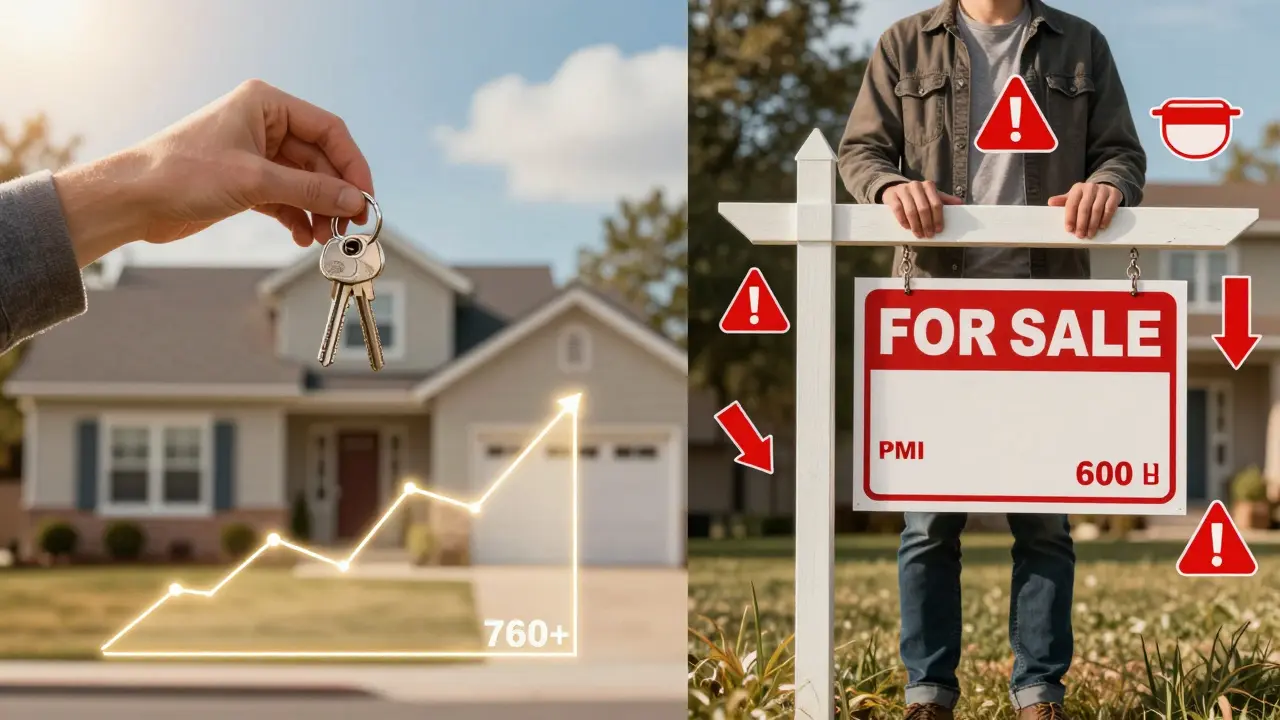
Your credit score is the single biggest factor in whether you get approved - and at what rate. Most lenders want at least a 620 score for a conventional loan. FHA loans accept 580 with 3.5% down. But if your score is below 620, you’re looking at higher rates, stricter terms, or outright rejection.
Here’s what happens at different score levels:
- 760+ → Best rates (around 6.2% for a 30-year fixed)
- 700-759 → Slightly higher rates (about 6.5%)
- 640-699 → Noticeably higher rates (7% or more)
- Below 620 → Limited options, often only FHA or subprime loans
Check your credit report at AnnualCreditReport.com. Look for errors - late payments that aren’t yours, accounts you didn’t open, or outdated collections. Dispute them. Fixing one error can raise your score by 50 points. That could save you $150 a month on your mortgage.
Debt-to-Income Ratio: The Number Lenders Watch Most
Even with great credit, you can still be denied if your debt-to-income ratio (DTI) is too high. This is your total monthly debt payments divided by your gross monthly income. Lenders want it under 43%. Some allow up to 50%, but that’s rare.
Let’s say you make $6,000 a month before taxes. Your debts include:
- Car payment: $400
- Student loan: $300
- Credit card minimums: $200
- Child support: $500
Your total debt payments = $1,400. Your DTI = 1,400 ÷ 6,000 = 23%. That’s great. But if you add a $1,200 monthly rent payment and plan to take on a $2,000 mortgage, your DTI jumps to 60%. That’s a red flag.
Pay down debt before applying. Close unused credit cards. Don’t take on new loans. Even a new car payment right before applying can kill your approval.
Job Stability and Income Proof
Lenders don’t just look at your paycheck. They want to see that you’ll keep getting paid. Most require two years of steady employment. If you switched jobs recently, that’s okay - as long as you stayed in the same field. A promotion? Even better.
Self-employed? You’ll need two years of tax returns, profit-and-loss statements, and bank statements. Lenders average your income over those two years. If you made $80,000 one year and $50,000 the next, they’ll use $65,000. That can hurt your borrowing power.
Don’t quit your job to start a business right before applying. Don’t switch from W-2 to 1099 unless you’ve been doing it for at least two years. Lenders hate uncertainty.
Types of Real Estate Loans Compared
Not all loans are created equal. Here’s how the most common ones stack up:
| Loan Type | Minimum Down Payment | Minimum Credit Score | Best For | Downside |
|---|---|---|---|---|
| Conventional | 3% | 620 | Buyers with strong credit and savings | Requires PMI under 20% down |
| FHA | 3.5% | 580 | First-time buyers, lower credit scores | Mortgage insurance lasts for life if down payment <10% |
| VA | 0% | Varies (usually 620) | Eligible veterans and active duty | Funding fee (1.4%-3.6%) |
| USDA | 0% | 640 | Buyers in rural areas | Income limits apply; limited locations |
| ARM (5/1) | 5% | 620 | Planning to move in 5-7 years | Rate can jump after initial period |
What Gets You Denied - And How to Fix It
Here are the top five reasons people get turned down - and what to do about it:
- Too much debt → Pay down credit cards, consolidate loans, delay the purchase.
- Low credit score → Dispute errors, pay bills on time for 6-12 months, avoid new credit applications.
- Inconsistent income → Wait until you’ve been in your job for two years, or get a co-signer.
- Insufficient cash reserves → Save 2-3 months of mortgage payments after closing. Lenders want to see you can handle emergencies.
- Property issues → Appraisals can kill a deal. Make sure the home passes inspection. Fix major problems before applying.
If you’re denied, ask for a written explanation. Lenders are required to give it. Then, fix the issue before reapplying. Don’t just reapply with the same numbers.
How to Get the Best Rate
Don’t just go to your bank. Shop around. Get quotes from at least three lenders: a big bank, a credit union, and an online lender. Rates can vary by 0.5% or more. On a $300,000 loan, that’s $90 a month - or $32,400 over 30 years.
Ask about discount points. One point = 1% of the loan amount. Paying $3,000 upfront to lower your rate from 6.5% to 6.25% might make sense if you plan to stay in the home for 10+ years. But if you’ll move in five, skip it.
Lock your rate early. Rates change daily. Once you’re approved, lock it in for 30-60 days. Don’t wait for it to drop - it might go up instead.
Final Checklist Before Applying
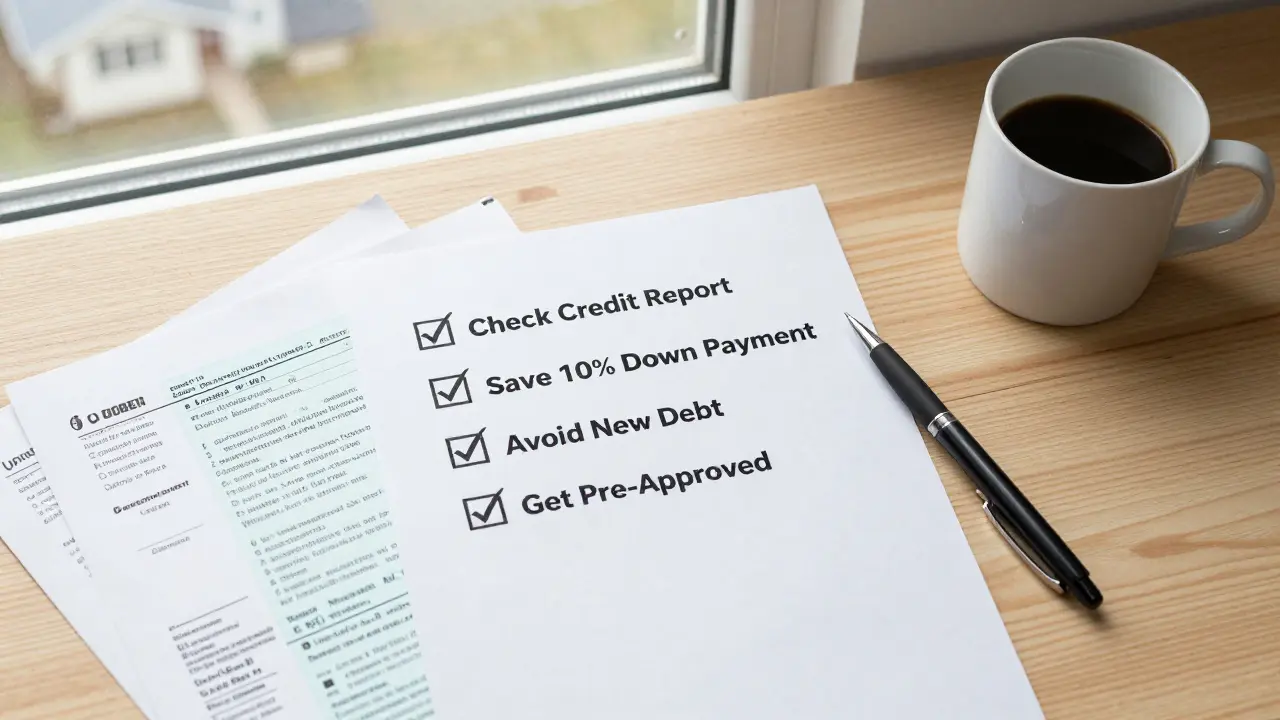
- Check your credit report and fix errors
- Pay down credit card balances
- Save for down payment and closing costs (2-5% of home price)
- Collect 2 years of tax returns and pay stubs
- Avoid big purchases (cars, furniture, etc.) before closing
- Get pre-approved - not just pre-qualified
Pre-approval means a lender has checked your finances and given you a written commitment. Pre-qualified is just a guess. Sellers won’t take you seriously without pre-approval.
What Comes After Approval
Approval isn’t the finish line. You still need to:
- Complete the home inspection
- Get an appraisal (lender requires it)
- Buy homeowners insurance
- Sign closing documents
- Pay closing costs (typically 2-5% of loan amount)
Don’t be surprised if your loan officer asks for more paperwork at the last minute. That’s normal. Stay calm. Keep your finances stable. Don’t open new credit cards. Don’t change jobs. Don’t make large deposits without explaining them.
Once you close, you’re a homeowner. But your loan journey isn’t over. Make payments on time. Monitor your credit. Refinance later if rates drop - but only if you’ll stay in the home long enough to break even on closing costs.
Can I get a real estate loan with bad credit?
Yes, but your options are limited. FHA loans accept scores as low as 580. If your score is below that, you may need a co-signer or wait to improve your credit. Expect higher interest rates and mandatory mortgage insurance. Fixing your credit before applying can save you tens of thousands.
How long does it take to get approved for a real estate loan?
Typically 30 to 45 days from application to closing. If you’re well-prepared - documents ready, credit clean, income documented - it can be done in 21 days. Delays usually come from missing paperwork, appraisal issues, or last-minute credit checks.
Do I need a real estate agent to get a loan?
No. You can apply for a loan without an agent. But agents help you find homes that fit your budget and negotiate terms. Lenders don’t require one, but most buyers use them because they know the market and can speed up the process.
Can I get a real estate loan if I’m self-employed?
Yes, but it’s harder. You’ll need two years of tax returns, profit-and-loss statements, and bank records. Lenders average your income over that time. If your income dropped last year, you might need a larger down payment or a co-signer to qualify.
What’s the difference between pre-qualification and pre-approval?
Pre-qualification is a rough estimate based on what you tell the lender. Pre-approval means the lender verified your income, credit, and assets. Sellers only trust pre-approval. It shows you’re serious and financially ready to buy.